
 It’s & We’re Always Open!
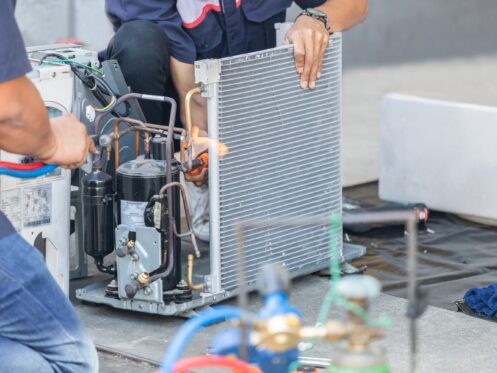
Energy efficiency is one of the main things to focus on when installing a new air conditioner or heat pump. As technology continually advances, manufacturers are producing units that are far more efficient than those produced even a decade ago. The only real concern is that the highest-efficiency units can be prohibitively expensive for many families. These systems typically don’t provide significant enough energy savings over their life to justify the much higher cost. This is where SEER2 ratings are beneficial. That is because they allow you to estimate annual energy consumption. You can then compare different options to see which one will provide you with the best return on your investment.
What Are SEER2 Ratings?
The fact that the main part of an AC or a heat pump system is outside means that the system’s efficiency is directly impacted by the outdoor air temperature and the humidity level. Cooling systems work most efficiently when the temperature and humidity are lower. Extreme heat and high humidity make it more difficult for the system to release the heat it removed from inside the house. That results in longer run times and a decrease in efficiency. SEER2 ratings take these normal fluctuations in efficiency into account by averaging out the overall efficiency across an entire cooling season.
How Is SEER2 Calculated?
The first step in calculating a unit’s SEER2 rating is to test it to see how efficiently it cools in different conditions. This allows the testing laboratory to estimate the total watt-hours of electricity the unit would use in a typical cooling season lasting from late spring to early fall. Once you have the total yearly energy consumption, you can calculate SEER2 by dividing the number of BTUs of cooling the unit puts out by the total watt-hours of energy consumed. The higher the SEER2 value is, the more efficiently the unit works and the less it will cost to run.
What’s the Difference Between SEER and SEER2?
Before 2023, cooling efficiency was measured using the original SEER rating system. Research showed that SEER ratings weren’t always that accurate. That is because the testing conditions were more optimal than those you find in most homes. This is why the US Department of Energy mandated the switch to the new SEER2 system, which was designed to more accurately reflect real-world conditions.
Both ratings are calculated in the same way. The only difference is that SEER2 tests units at a higher static pressure, which refers to the amount of airflow resistance inside the ductwork. Most HVAC systems have at least some issues that contribute to increased static pressure. These are such factors as undersized ducts, obstructed vents, or a dirty air filter, and the SEER2 testing parameters are designed to take this into account. SEER2 ratings are typically between 4% and 7% lower than SEER ratings. That makes them a more precise way to estimate an AC or a heat pump’s seasonal energy consumption.
How to Use SEER2 to Estimate Potential Energy Savings
SEER2 ratings make it fairly easy to compare different units. That will allow you to estimate how much you can save on your energy bills by opting for a higher-efficiency AC replacement or new heat pump. Each higher SEER2 value is equal to an approximately 7% increase in annual efficiency. Let’s say your current unit is 12 SEER, which is roughly equivalent to 11.5 SEER2. If you were to install a new 15 SEER unit, you’d lower your annual cooling bills by around 25% from what they currently are.
The minimum efficiency rating required by federal law for all new ACs and heat pumps in New Jersey is 14.3 SEER2. In the following charts, you can see approximately how much you’d save per year. This is if you chose a higher SEER2 unit compared to a 14.3 SEER2 unit based on the current average electricity rates in New Jersey.
3-Ton, 36,000-BTU Unit
- 15 SEER2: Estimated annual savings of approximately $50
- 17 SEER2: Approximately $100
- 20 SEER2: Approximately $160
- 24 SEER2: Approximately $210
- 28 SEER2: Approximately $250
5-Ton, 60,000-BTU Unit
- 15 SEER2: Estimated annual savings of approximately $90
- 17 SEER2: Approximately $170
- 20 SEER2: Approximately $270
- 24 SEER2: Approximately $340
- 28 SEER2: Approximately $420
What Is a Good SEER2 Rating?
The best SEER2 rating really depends on what your budget is, where you live, and what your primary goals are. If money is no object, you should obviously go with the most efficient option available. As of writing, the most efficient central ACs and heat pumps are in the 26 to 28 SEER2 range. That will greatly reduce your home’s carbon footprint compared to lower SEER2 options.
You may be on a more limited budget. If so, it helps to compare costs and estimated energy savings for the various options in your price range. That will allow you to find the one that’s going to be the most cost-effective in the long term. The average lifespan of central cooling units is around 15 years. You can use this to estimate lifetime energy savings to see whether it’s worth paying more for a higher SEER2 unit.
Let’s say that you’re installing a 3-ton AC in New Jersey and trying to decide between a 15 SEER2 and a 20 SEER2 model. Over 15 years, the 20 SEER2 model would save you approximately $750. However, the initial cost of the 20 SEER2 model will likely be over $1,000 more than the 15 SEER2 model. That means the lifetime energy savings won’t offset the higher upfront cost.
Generally speaking, units with much higher SEER2 ratings make more sense in overly hot and humid climates. That is where the cooling system has to do much more work and uses much more energy. In hot climates and places with longer cooling seasons, experts generally recommend choosing a model in the 18 to 22 SEER2 range. Despite the increased initial cost, the energy savings you’d get with a unit in this range will typically help the unit to pay for itself over time. For milder climates with shorter winters, it rarely makes sense to install anything higher than 16 SEER2.
For New Jersey and much of the rest of the country, a unit that’s between 16 and 18 SEER2 provides the best balance of energy savings and upfront cost. If you went with a 20 SEER2 unit or higher, you’ll usually end up spending more overall due to the higher upfront cost.
There are often incentives available for homeowners who install a higher-efficiency AC or heat pump, such as utility rebates, which can help offset the higher cost. Most programs require that the unit be ENERGY STAR-certified, which is something to keep in mind when deciding which option to install. To receive an ENERGY STAR certification, split system ACs and heat pumps must be at least 17 SEER2. Packaged units must be at least 16 SEER2.
New Jersey’s HVAC Installation Professionals
If you’re looking to upgrade to a more efficient AC or heat pump, the “Caring Trusted Experts” at Pipe Works Services are ready to help. Our family-owned business has been serving homeowners in Northern and Central NJ for more than 25 years. We have the skills to professionally handle any HVAC installation from start to finish. We carry a range of quality, efficient cooling options from top brands like Lennox. Our knowledgeable, local technicians can help you find the best solution for your home and your budget. If you want to install a higher SEER2 option without breaking the bank, we have flexible financing options available on approved credit.
To schedule an installation consultation or any other HVAC service, contact us today.